

FINRA and the SEC have eliminated the pattern day trader designation and the $25,000 minimum equity requirement. As of June 4, 2026, intraday buying power is now calculated from your real-time intraday margin excess, not your prior-day closing balance. The old PDT trigger — four or more day trades in five business days — no longer automatically restricts your account.
That said, three things still demand your attention right now:
- Check your broker. Firms have until October 20, 2027 to fully implement the new standards. Your account may still operate under old PDT rules today.
- Review your margin disclosure. House margin policies can be stricter than the regulatory floor, and brokers retain that authority.
- Adjust your risk controls. Real-time intraday margin monitoring creates new ways to trigger a margin deficit, even without the old day-trade count.
FINRA, the SEC, and Investor.gov have all published guidance on the transition. Read your broker's updated disclosures before your next trading session.
Table of Contents
- What was the pattern day trader rule, exactly?
- What did FINRA and the SEC actually change?
- When does this take effect, and what are brokers doing about it?
- How does this change your actual trading?
- What should you do right now?
- Key Takeaways
- The real shift here is not the rule, it is the risk model
- Caliberengine gives you an automated risk layer for the new margin environment
- Useful sources
What was the pattern day trader rule, exactly?
The original PDT framework was built in the early 2000s to address problems that surfaced during the dot-com trading boom. SEC guidance defined a day trade as buying and selling the same security in a margin account on the same day. If you executed four or more such trades within any rolling five-business-day window, and those trades represented more than 6% of your total trading activity in that period, your broker was required to flag you as a pattern day trader.
Once flagged, the consequences were immediate:
- Your account needed to carry at least a minimum equity requirement at all times.
- You gained access to enhanced day-trading buying power, historically calculated as a multiple of your maintenance margin excess.
- If your equity fell below $25,000, your broker could restrict the account to liquidation-only status until you deposited enough to meet the minimum.
- Margin calls triggered by day-trading buying power violations had to be met within a specified period, or the account faced further restrictions.
For retail traders with smaller accounts, this was a hard wall. A $24,000 account could not legally day trade in a margin account under the old rules, full stop. Brokers like Charles Schwab and E*TRADE enforced these restrictions through automated account flags, and many traders found themselves locked out of intraday strategies with no warning. The rule applied specifically to margin accounts. Cash accounts were not subject to PDT designation, though they faced their own settlement-period constraints.
What did FINRA and the SEC actually change?
The short version: the PDT label is gone, the $25,000 floor is gone, and the day-trade count no longer triggers anything.
The amendments to FINRA Rule 4210 replace the day-trading margin provisions with intraday margin standards. Buying power is now determined by a customer's real-time intraday margin excess, not their prior-day closing figure or a fixed minimum equity threshold. Firms may compute intraday deficits once per day using an approximation of intraday positions, or they may monitor accounts continuously in real time — both approaches are permitted under the new rule.
What this means in practice: your intraday buying power fluctuates with your account's live margin position throughout the trading day. If your intraday margin excess is $10,000 at 10 AM, that figure drives your buying power at that moment. By 2 PM, if positions have moved against you, that number could be lower.
One notable addition: FINRA's Regulatory Notice 26-10 permits brokers to include cash held in FDIC-insured sweep programs as a credit balance when computing intraday margin deficits. That means funds swept to an affiliated bank overnight may count toward your intraday buying power the next morning, depending on how your broker handles it.

| Feature | Old PDT Framework | New Intraday Margin Standard |
|---|---|---|
| Designation trigger | 4+ day trades in 5 business days | No designation; no trade count |
| Minimum equity | $25,000 required | No regulatory minimum |
| Buying power basis | Prior-day maintenance margin excess | Real-time intraday margin excess |
| Sweep balances | Not counted | May be included as credit |
| Effective date | Pre-June 4, 2026 | June 4, 2026 |
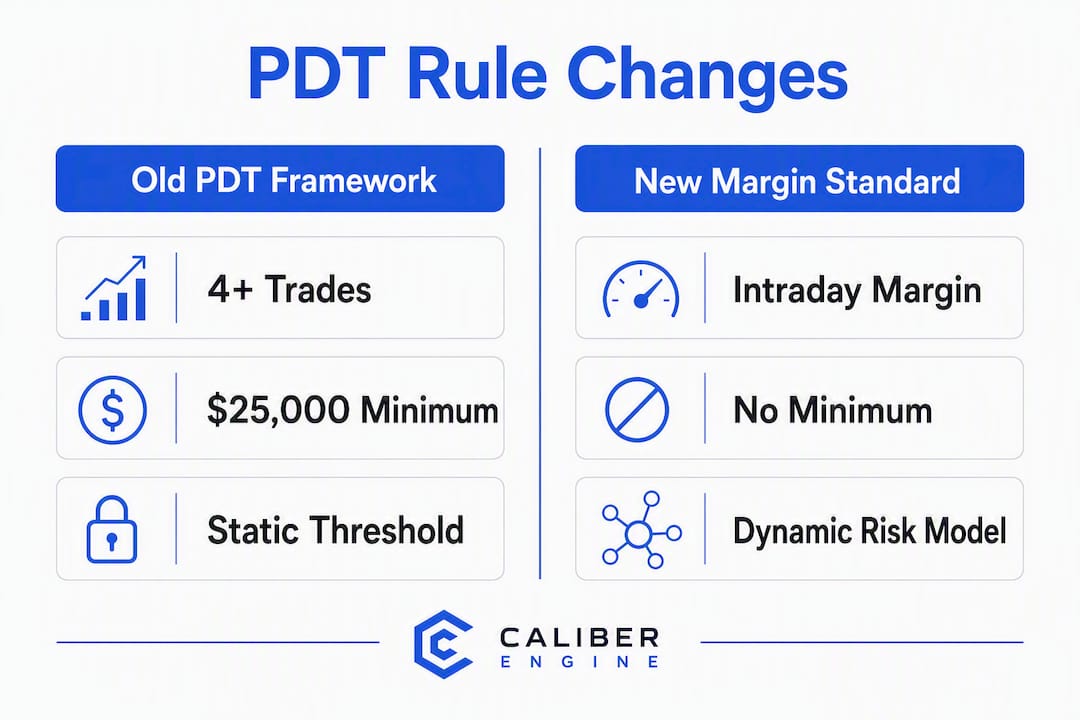
FINRA moved to this framework after years of industry feedback that the PDT rules were misaligned with modern, real-time trading infrastructure. The old system was designed for an era when end-of-day settlement was the norm. Today's platforms execute and clear positions in seconds.
When does this take effect, and what are brokers doing about it?
The rule became effective in mid-2026. But "effective" does not mean every broker flipped a switch that morning.
FINRA granted member firms a phased implementation window lasting over a year, running through late 2027. Firms that need more time to update their systems, margin calculation engines, and client disclosures can continue operating under prior standards during that window, provided they notify clients appropriately.
| Milestone | Date |
|---|---|
| SEC approval / rule effective date | June 4, 2026 |
| Broker implementation deadline | October 20, 2027 |
| Fragmented rollout period | June 4, 2026 through October 20, 2027 |
This creates a genuinely uneven landscape right now. Two traders at different brokers could have completely different buying-power experiences on the same day, trading the same securities, with the same account balance. One broker may already be running real-time intraday margin monitoring. Another may still be calculating buying power from prior-day close figures.
What brokers are generally doing during the transition:
- Updating margin disclosure documents and client agreements to reflect the new intraday standard.
- Modifying account management systems to compute intraday margin excess in real time or via end-of-day approximation.
- Revising buying-power displays in trading platforms and mobile apps.
- Publishing client notices explaining the transition timeline.
Major firms including Charles Schwab and ETRADE have published client-facing communications about the PDT rule change. ETRADE's guidance confirms that the PDT designation is going away and that buying power will be based on real-time intraday margin excess. Check your broker's help center or margin disclosure page directly — do not assume your account has already transitioned.
How does this change your actual trading?
The shift from a fixed $25,000 floor to real-time intraday margin excess sounds like pure freedom. It is more complicated than that.

Under the old PDT framework, your day-trading buying power was calculated based on prior-day closing values. You knew your number before the market opened. Under the new standard, that number moves with the market. A position that drops 3% by 11 AM reduces your intraday margin excess and therefore your buying power for the rest of the session. That is a meaningful operational change, especially for traders who run multiple simultaneous positions.
Intraday margin deficits (IMDs) are the new mechanism to watch. If your account's intraday positions create a margin deficit, your broker can require you to deposit funds, liquidate positions, or both. Firms may also take automatic action to resolve an IMD without waiting for you to respond. The speed of that response depends entirely on your broker's implementation.
Sweep balances add another layer. If your broker counts FDIC-insured sweep funds as intraday credit, cash sitting in a money market sweep account could increase your effective buying power. But those funds may not be immediately available for trading, and the timing of when they are counted varies by firm. Ask your broker specifically whether sweep balances are included in your intraday margin excess calculation.
Pro Tip: Set your personal intraday leverage limit well below your broker's maximum. If your broker allows 4x intraday margin, trading at 2x gives you a buffer against unexpected IMDs when positions move against you mid-session.
A few risk realities worth naming:
- Small accounts benefit from the removal of the $25,000 floor, but they also face the greatest volatility in intraday buying power because a small adverse move represents a larger percentage of their margin excess.
- FINRA Rule 2270 still requires brokers to disclose that day trading is risky and often unsuitable for traders with limited capital. The rule change does not alter that underlying risk reality.
- Broker house rules can still impose stricter minimums than the regulatory floor. A firm could require $10,000, $15,000, or any other figure as a house policy, and that is entirely legal.
Pro Tip: Before your first session under the new rules, run a small test trade and watch how your buying-power display changes in real time. This tells you whether your broker is already using live intraday calculations or still running prior-day figures.
What should you do right now?
The rule change is live, but your broker's implementation may not be. Here is a prioritized sequence.
- Contact your broker directly. Ask whether your account has transitioned to the new intraday margin standard or is still operating under prior PDT rules. Get the answer in writing, via email or secure message.
- Read your updated margin disclosure. Brokers are required to update these documents. The new version will describe how intraday margin excess is calculated, whether sweep balances count, and what happens when an IMD occurs.
- Confirm sweep balance treatment. Ask specifically: "Are funds in my sweep program counted as intraday margin credit, and if so, at what point in the trading day?"
- Enable margin alerts. Most platforms let you set notifications when buying power drops below a threshold. Configure these before you trade, not after a deficit surprises you.
- Reduce intraday leverage temporarily. Until you understand how your broker's system behaves under the new standard, trade at lower leverage. You can always scale up once you have observed the buying-power behavior across a few sessions.
- Clarify your account type. Cash accounts, portfolio margin accounts, and funded prop-trading accounts each operate under different rules. Confirm which category applies to you and what the new standard means for that specific account type.
Pro Tip: Document every conversation with your broker's customer service team. Screenshot your buying-power display at the start and end of each session for the first few weeks. If a dispute arises over an IMD or a margin call, that documentation is your evidence.
Pro Tip: If you use a funded prop-trading account, the PDT rule change may not apply the same way. Prop firms set their own internal margin rules. Contact your provider separately to understand their policy.
Key Takeaways
The FINRA/SEC amendments eliminate the PDT designation and $25,000 minimum, replacing them with real-time intraday margin standards effective June 4, 2026, though broker implementation varies through October 20, 2027.
| Point | Details |
|---|---|
| PDT designation eliminated | The four-trade trigger and $25,000 minimum are gone under the new FINRA Rule 4210 amendments. |
| Intraday margin is now live | Buying power moves with your real-time margin excess throughout the trading session, not a prior-day figure. |
| Broker rollout is uneven | Firms have until October 20, 2027 to implement; your broker may still use old PDT rules today. |
| House rules still apply | Brokers can impose stricter minimums than the regulatory floor, so confirm your firm's specific policy. |
| Caliberengine for risk control | Automated intraday monitoring and pre-trade checks help traders avoid surprise margin deficits under the new standard. |
The real shift here is not the rule, it is the risk model
The removal of the PDT designation is genuinely good news for retail traders. The $25,000 floor was always a blunt instrument. It did not make traders safer. It just kept smaller accounts out of intraday strategies entirely, while doing nothing to prevent well-capitalized traders from taking reckless positions. The rule was a product of its era, designed when regulators were reacting to margin blow-ups in 1999 and 2000, not anticipating the real-time infrastructure of 2026.
What the new framework does is shift the risk model from a static threshold to a dynamic one. That is more sophisticated, and in theory more accurate. But it also means the safety net is now invisible. Under the old rules, you knew exactly where the floor was: $25,000. Under the new standard, your floor moves every minute the market is open. Traders who were disciplined under the old framework because the rules forced them to be will need to internalize that discipline themselves.
The traders who will struggle are not the ones who lacked $25,000. They are the ones who mistake the removal of a restriction for the removal of risk. FINRA's day-trading risk disclosure has not changed. The capital requirements for sustainable day trading have not changed either. Experts often cite a larger account balance as a rough threshold for viable long-term day trading, not because of any regulatory requirement, but because costs, slippage, and margin volatility affect smaller accounts more significantly.
The opportunity here is real. The discipline required to use it well is exactly what it always was.
Caliberengine gives you an automated risk layer for the new margin environment
The new intraday margin standard rewards traders who can monitor buying power in real time and act before a deficit forces their broker's hand. That is precisely where automation earns its keep.
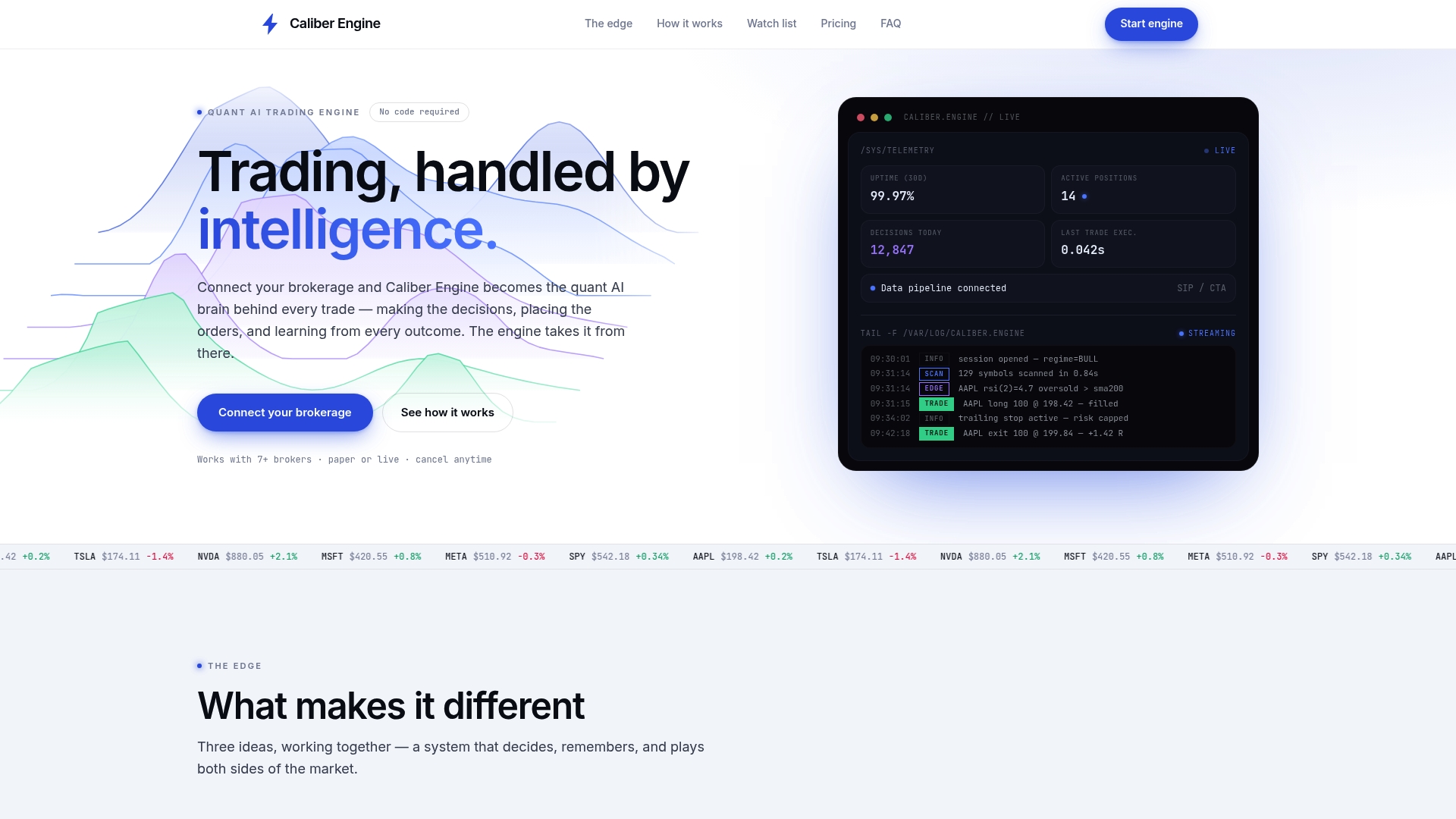
Caliberengine is an autonomous quantitative AI trading platform that integrates directly with your brokerage account to monitor positions, execute trades, and enforce pre-set risk parameters without requiring you to watch a screen all day. Under the new intraday margin rules, that kind of systematic oversight matters more than it did under the old PDT framework. Caliberengine processes over 12,000 trading decisions per day, applies self-learning optimization from past trade outcomes, and can operate in fully autonomous mode or signal-only mode depending on your preference. You set the leverage limits and intraday stop thresholds. The platform enforces them.
For traders navigating the transition period, where broker implementations vary and buying-power behavior is still unpredictable, a systematic pre-trade check layer reduces the chance of a surprise IMD. Start with a free trial at Caliberengine to see how automated risk controls fit your trading style. Note that broker margin policies govern your account regardless of any platform you use.
Useful sources
- FINRA Regulatory Notice 26-10: Intraday Margin Standards (Rule 4210 amendments) — the primary regulatory document governing the PDT rule change, effective dates, and intraday margin mechanics.
- SEC Rule Filing: Proposed Amendment to FINRA Rule 4210 — the SEC's official filing with the full text of the proposed rule change and regulatory rationale.
- Margin Rules for Day Trading | SEC / Investor.gov brochure — explains the historical PDT framework and the $25,000 minimum; useful for understanding what the new rule replaces.
- Pattern Day Trader | Investor.gov glossary — plain-language explanation of the PDT definition and broker discretion during the transition.
- FINRA Rule 2270: Day-Trading Risk Disclosure Statement — the continuing risk disclosure requirement that applies regardless of the PDT rule change.