

Start with a small, backtested strategy on a US-compatible AI trading platform that offers paper trading, run it in demo mode for at least four weeks, then go live with only what you can afford to lose. That single sequence keeps most beginners out of trouble. The reason it works: automation removes the two biggest killers of retail performance, emotional panic selling and FOMO-driven chasing, while paper trading surfaces the execution problems that historical backtests always hide.
Your three-step TL;DR:
- Set a clear goal and a hard capital limit before touching any platform.
- Backtest your chosen strategy, then paper-trade it for at least a month.
- Go live small, monitor weekly, and scale only after consistent results.
For US beginners looking for a ready-to-run on-ramp, Caliberengine offers autonomous AI trading with paper-trading mode, US broker integrations, and no coding required. It is the platform this guide returns to throughout.
AI trading, in practical terms, means software that analyzes market data, generates trade signals, and executes orders automatically, without you clicking a button. The industry term is quantitative trading or algorithmic trading, and it covers a wide spectrum. At one end sit simple rule-based scripts ("buy when the 50-day moving average crosses above the 200-day"). At the other end sit machine-learning models that adapt their parameters as new data arrives.
That adaptability is the key difference between traditional algorithmic trading and modern AI-driven systems. A classic algo follows fixed rules forever. An ML-driven system updates its internal model based on what it observes, which makes it more flexible but also more prone to overfitting if validation is sloppy. According to Investopedia's quantitative trading overview, analysts consistently highlight emotional neutrality as the primary retail benefit of automated execution, because the system never second-guesses itself at 2 AM.
Algorithmic trading already accounts for a substantial share of US equity and FX volume, spanning strategies from trend-following to high-frequency arbitrage. Individual investors now have access to the same infrastructure through subscription platforms and API-first brokerages, which is a relatively recent development worth taking seriously.
Table of Contents
- What can AI trading actually do for you — and what can't it?
- How does an AI trading system actually work?
- How do you start AI trading safely as a beginner?
- What should you check before choosing an AI trading platform?
- How do you backtest an AI strategy without fooling yourself?
- What risk rules should every beginner enforce?
- Which beginner AI trading strategies are worth starting with?
- Why Caliberengine works as a first platform for US beginners
- Key Takeaways
- What most beginners get wrong about AI trading
- Caliberengine: the practical next step for US beginners
- Useful sources and further reading
What can AI trading actually do for you — and what can't it?
The benefits are real, but so are the limits. Knowing both upfront saves you from the most expensive beginner mistakes.
Real benefits:
- Emotion-neutral execution. The system follows its rules regardless of whether the market is crashing or surging. No panic sells, no FOMO buys.
- 24/7 monitoring. Automated systems watch positions around the clock, something no individual trader can sustain.
- Speed. Order execution happens in milliseconds, faster than any manual process.
- Systematic record-keeping. Every trade is logged with entry, exit, and rationale, which makes performance review straightforward.
Practical limits:
- No guarantees. Any platform or service promising consistent profits is a red flag, full stop.
- Overfitting risk. A model trained too tightly on historical data performs beautifully in backtests and poorly in live markets.
- Data-quality dependency. Garbage in, garbage out. Poor data feeds produce unreliable signals.
- Slippage and execution gaps. Live fills rarely match backtest assumptions, especially in fast or illiquid markets.
Pro Tip: Set your performance benchmark before you start, not after. Decide in advance what a "good" month looks like (e.g., staying within a 5% drawdown while generating any positive return). Without a pre-set benchmark, you will always rationalize results.
One-sentence risk callout: AI trading does not eliminate market risk; it systematizes how you take it, which is only an advantage if the underlying strategy has a genuine edge.
How does an AI trading system actually work?
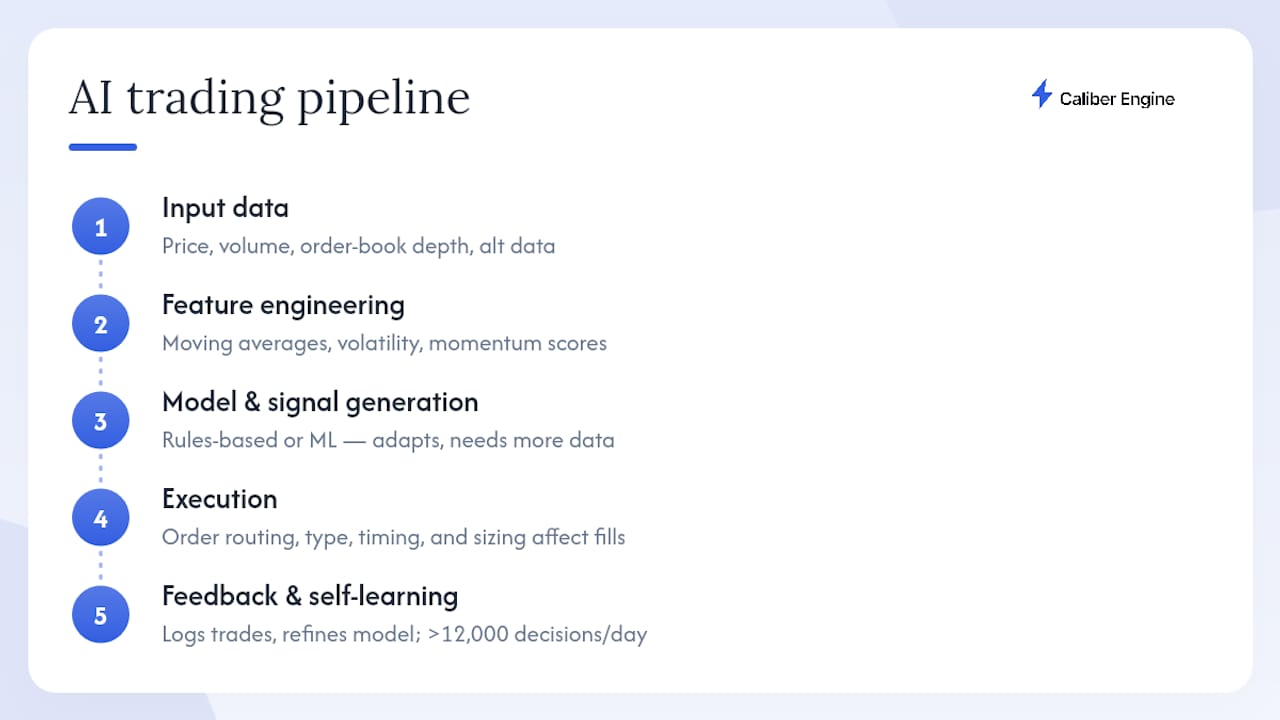
The pipeline has five stages, and understanding them helps you evaluate any platform you consider.
1. Input data. The system ingests price, volume, order-book depth, and sometimes alternative data like earnings sentiment or options flow. Data quality and latency at this stage determine the ceiling on everything downstream.
2. Feature engineering. Raw data gets transformed into signals the model can use: moving averages, volatility measures, momentum scores. This step is where most of the domain knowledge lives.
3. Model and signal generation. A rules-based bot applies fixed logic ("if RSI < 30, buy"). An ML-driven model, including reinforcement learning systems, adjusts its parameters based on feedback from past outcomes. The ML approach adapts to changing regimes but requires far more data and validation to avoid overfitting.
4. Execution. The signal triggers an order routed to a broker. Order type (market vs. limit), timing, and position sizing all affect the actual fill price versus the theoretical one.
5. Feedback and self-learning. The most advanced platforms log each trade's outcome and feed it back into the model. Caliberengine's self-learning loop, for example, memorizes past trades and their results to refine future decisions over time, which is the mechanism behind its claimed throughput of over 12,000 trading decisions per day.
Pro Tip: When evaluating a platform, ask specifically how the model's decisions are logged and whether you can review the trade rationale. Platforms that expose a trade-by-trade audit trail give you the feedback loop you need to improve.
The practical difference for beginners: no-code platforms let you observe a live strategy without writing a line of code, which is the gentlest on-ramp available. Python-based tools like Backtrader, Pandas, and NumPy offer more control but require a steeper learning curve. Most beginners should start no-code and graduate to code-based tools only when they have a clear reason to.
How do you start AI trading safely as a beginner?
Follow this sequence. Skipping steps, especially paper trading, is where most beginners lose money they did not need to lose.
- Define your goal and risk tolerance. Are you targeting long-term portfolio growth, supplemental income, or learning? Your answer determines strategy type and acceptable drawdown. Write it down.
- Set a hard capital limit. Commit only funds you can afford to lose entirely. Many guides suggest starting with no more than 5–10% of your investable assets.
- Choose a US-compatible broker. You need a broker with an API or direct platform integration. Interactive Brokers, TD Ameritrade (now Schwab), and Alpaca are commonly used with automated systems.
- Select a platform with paper trading. This is non-negotiable. Paper trading surfaces API quirks, partial fills, and live slippage that historical simulations never reveal.
- Backtest your chosen strategy. Run it on historical data with realistic commission and slippage assumptions. Require out-of-sample results before trusting any backtest number.
- Paper-trade for at least four weeks. One month is the minimum to observe the strategy across different market conditions. Longer is better.
- Go live with a small allocation. Start with the smallest position size your broker allows. Observe for another four weeks before adding capital.
- Monitor weekly, not daily. Daily monitoring encourages tinkering. Weekly reviews catch real problems without generating noise-driven interventions.
- Scale only after consistent results. "Consistent" means the live performance tracks the paper-trading period within a reasonable band, not that you are profitable every week.
A step-by-step beginner path following this exact order is the approach most published guides converge on for first-time users.
Realistic timeline:
- Weeks 1–2: Research, goal-setting, broker and platform selection.
- Weeks 3–6: Backtesting and strategy selection.
- Weeks 7–10: Paper trading.
- Week 11+: Live trading with minimum allocation.
Readiness checklist before going live:
- Strategy has passed out-of-sample backtest.
- Paper-trading results are within expected range of backtest.
- You understand every parameter the strategy uses.
- You have set a max drawdown limit at which you will pause the strategy.
- Fees and order routing are fully understood.
What should you check before choosing an AI trading platform?
Not all platforms are built the same, and the differences matter more than the marketing copy suggests.
Core criteria:
- No-code vs. API access. Beginners should prioritize no-code interfaces with pre-built strategies. API access is valuable later but adds friction early.
- US broker integrations. Confirm the platform connects to brokers available to US retail investors. A platform with no US-compatible broker integration is useless to you.
- Paper/demo trading. Non-negotiable. If a platform does not offer it, move on.
- Fee transparency. Understand the subscription cost, any per-trade fees, and whether the platform takes a cut of profits. Hidden fees erode returns faster than most beginners expect.
- Regulatory and security signals. Look for clear terms of service, data encryption disclosures, and whether the platform has been operating long enough to have a track record.
Operational checks:
- Does the backtest engine model slippage and commissions realistically? Execution quality and realistic transaction-cost simulation are what close the gap between backtest and live performance.
- Can you see out-of-sample test results, not just in-sample curves?
- What data sources does the platform use, and what is the latency?
- How are orders routed, and can you verify fill quality?
Red flags checklist:
- Any promise of guaranteed returns or "risk-free" profits.
- Backtests shown only on in-sample data with no out-of-sample validation.
- Opaque fee structures or profit-sharing terms buried in fine print.
- No paper-trading or demo mode.
- No clear explanation of how the model makes decisions.
Pro Tip: Run the same strategy in paper mode on two different platforms if you can. Differences in fill prices and execution timing will tell you more about platform quality than any marketing claim.
How do you backtest an AI strategy without fooling yourself?
Backtesting is non-negotiable, but a backtest run carelessly is worse than no backtest at all. It gives you false confidence.
Must-run validation steps:
- Out-of-sample testing. Train the strategy on one period (say, 2015–2020), then test it on data it has never seen (2021–2023). If performance collapses out-of-sample, the strategy is overfit.
- Walk-forward testing. Roll the training window forward in time and re-test repeatedly. This mimics how the strategy would have performed if deployed in real time.
- Realistic slippage and commission modeling. Assume you pay more than the mid-price on every fill. Even a $0.01 per-share slippage assumption changes results materially over hundreds of trades.
- Look-ahead bias check. Confirm the strategy never uses data that would not have been available at the time of the signal.
- Survivorship bias check. If you are testing on a stock universe, make sure delisted companies are included in the historical data.
Minimal metrics to track:
| Metric | What it measures | Acceptable starting range |
|---|---|---|
| Sharpe ratio | Risk-adjusted return | Above break-even in out-of-sample |
| Max drawdown | Worst peak-to-trough loss | Below 20% for beginners |
| CAGR | Annualized compound return | Positive and realistic |
| Win rate | Percentage of profitable trades | Context-dependent; a substantial portion is common |
| Trades per year | Strategy activity level | Enough to be statistically meaningful |
Common pitfalls and quick fixes:
- Data snooping. Testing dozens of parameter combinations and reporting the best one inflates results. Fix: pre-register your parameter choices before running the backtest.
- Over-optimization. A strategy with 15 parameters tuned to historical data will fail live. Fix: use the fewest parameters that produce a coherent result.
- Too-short test windows. A two-year backtest covering only a bull market tells you almost nothing. Fix: test across at least one full market cycle, including a significant drawdown period.
A strategy that survives all of these checks still carries no guarantee of future performance, but it at least has a defensible basis for going to paper trading.
What risk rules should every beginner enforce?
Risk management is where most beginners underinvest their attention. The strategy gets all the glamour; the risk controls do the actual work of keeping you in the game.
Core rules:
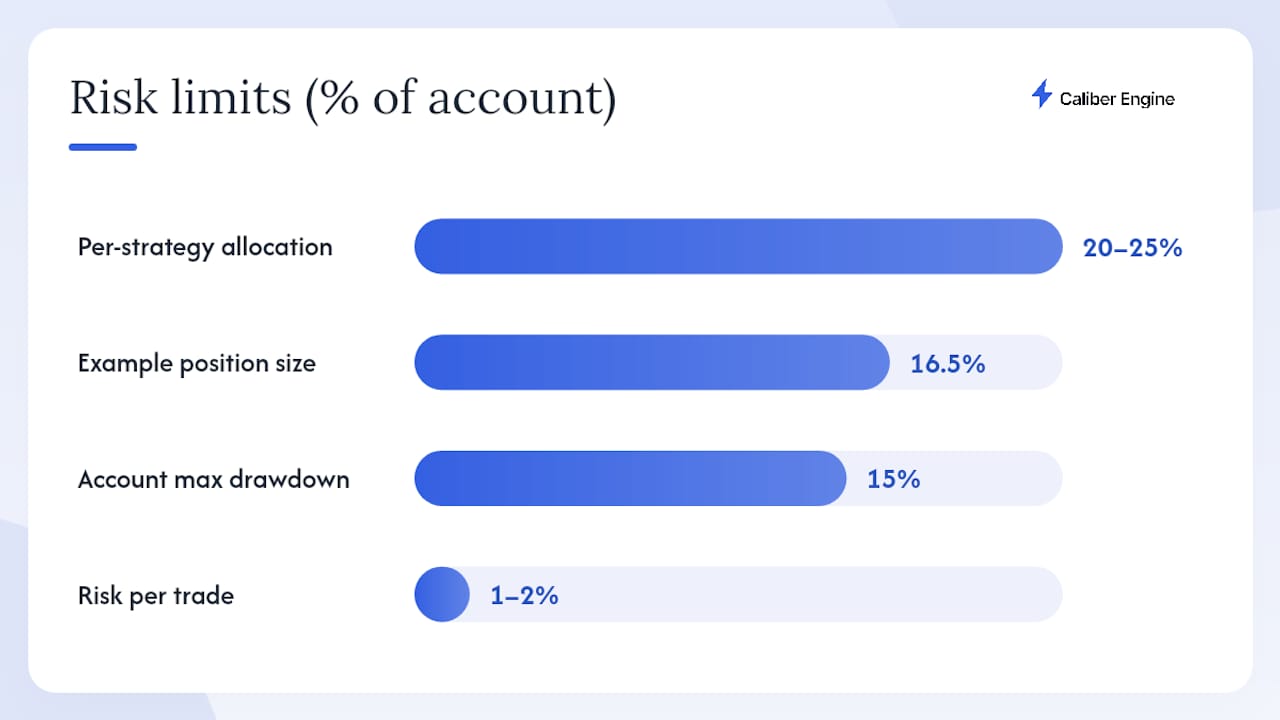
- Fixed-fraction position sizing. Risk a fixed percentage of your account on each trade, typically 1–2%. A $10,000 account risking 1% per trade means a maximum loss of $100 per position before the stop triggers.
- Kelly Criterion caution. The Kelly formula suggests an "optimal" bet size, but full Kelly is almost always too aggressive for retail traders. Use half-Kelly or less as a ceiling.
- Per-strategy max allocation. No single automated strategy should control more than 20–25% of your total investable capital until it has a live track record of at least six months.
- Account-level max drawdown limit. Set a hard threshold, say 15%, at which you pause all strategies and review. This prevents a bad month from becoming a catastrophic one.
- Stop-loss on every position. Automated or not, every open position needs a defined exit if it moves against you.
Quick position sizing example:
Account size: $10,000. Risk per trade: 1% = $100. Entry price: $50. Stop-loss: $47 (a $3 per-share risk). Maximum shares to buy: $100 / $3 = 33 shares. Total position value: $1,650, or 16.5% of the account. That keeps a single bad trade from doing serious damage.
- Calculate your per-trade risk in dollars (account × risk percentage).
- Determine the distance from entry to stop-loss in dollars per share.
- Divide step 1 by step 2 to get maximum share count.
- Confirm the resulting position size does not exceed your per-strategy allocation cap.
- Set the stop-loss order before or simultaneously with the entry order.
Pro Tip: Check your automated strategy's open positions at least once a week, even if it is fully autonomous. Market conditions can shift in ways that make a previously sound strategy behave unexpectedly. Knowing when to pause is as valuable as knowing when to run.
Which beginner AI trading strategies are worth starting with?
Simpler strategies with a clear, logical basis tend to outperform complex ML models in real retail trading, particularly when the trader does not yet have the data volume or validation expertise to support a sophisticated model. That is not a knock on ML; it is a practical observation about where beginners actually are.
Strategy categories worth exploring:
- Moving-average trend-following. Buy when a short-term average crosses above a long-term average; sell when it crosses below. Widely understood, easy to backtest, and logically grounded in momentum persistence.
- Momentum filters. Rank assets by recent return and hold the top performers. Works across asset classes and has decades of academic support.
- Dollar-cost averaging / steady allocation. Invest a fixed dollar amount on a fixed schedule regardless of price. Not a trading strategy in the active sense, but automating it removes timing anxiety entirely.
- Volatility targeting. Adjust position size inversely to recent volatility so the portfolio takes roughly equal risk in calm and turbulent periods.
- Simple ML signal ensembles. Combine two or three simple signals (momentum, mean-reversion, volume trend) using a lightweight model. More complex than the above but still tractable for a beginner with some Python experience.
Strategy behavior at a glance:
| Strategy | Trade frequency | Typical drawdown profile | Holding period |
|---|---|---|---|
| Moving-average trend-following | Low (monthly rebalance) | Moderate, slow to recover | Weeks to months |
| Momentum filter | Medium (weekly/monthly) | Moderate, sharp in reversals | Days to weeks |
| Dollar-cost averaging | Fixed schedule | Mirrors market drawdowns | Long-term |
| Volatility targeting | Medium (dynamic sizing) | Lower volatility, smaller wins | Days to weeks |
| Simple ML ensemble | Medium to high | Variable, model-dependent | Hours to days |
Two starter examples:
50/200 moving average crossover on SPY. Buy SPY when the 50-day SMA crosses above the 200-day SMA; sell (or go to cash) when it crosses below. This is the "golden cross / death cross" system. It misses the first part of every rally and the first part of every decline, but it keeps you out of the worst sustained downtrends.
Monthly momentum on a small ETF universe. Each month, rank five to ten broad ETFs by their 12-month return and hold the top two. Rebalance monthly. Simple to implement, easy to backtest, and the logic (recent winners tend to keep winning over intermediate horizons) has a long empirical track record.
Pro Tip: Before adding any complexity to a strategy, ask whether the added parameter improves out-of-sample results or only in-sample ones. If it only helps in-sample, it is curve-fitting, not improvement.
Why Caliberengine works as a first platform for US beginners
Caliberengine checks the criteria from the platform selection section in a way that matters specifically for beginners. It connects directly to US brokerage accounts, executes trades autonomously without requiring you to write code, and offers a paper-trading mode so you can watch the system operate before any real money is at risk.
The self-learning feature is the differentiator worth understanding. Caliberengine logs each trade and its outcome, then uses that record to refine future decisions. For a beginner, this means the platform gets more calibrated to actual market conditions over time rather than running a static ruleset indefinitely. The audit trail also gives you something to review: you can see why a trade was taken, which is the feedback loop that accelerates learning.
Feature alignment with the buyer checklist:
- Paper/demo trading mode: available, allowing risk-free observation before going live.
- US broker integrations: confirmed, with direct account connectivity.
- No coding required: the platform handles execution autonomously.
- Backtest transparency: trade outcomes are documented for review.
- Self-learning optimization: the system refines its approach based on logged trade history.
- Subscription pricing: structured tiers for either fully autonomous trading or signal-only alerts.
Caliberengine claims to process over 12,000 trading decisions in a single day, which reflects a system operating at a speed and consistency no manual trader can match.
Pro Tip: Start with Caliberengine's paper-trading mode for a full four weeks before switching to live. Use that period to verify that the platform's execution matches your expectations and that you understand how to read its trade log.
Key Takeaways
AI trading for beginners works best when you start with a simple, backtested strategy in paper-trading mode, enforce strict position-sizing rules, and scale only after live results confirm what the backtest suggested.
| Point | Details |
|---|---|
| Paper trading first | Run any strategy in demo mode for at least four weeks before committing real capital. |
| Backtest rigorously | Require out-of-sample and walk-forward results; never trust in-sample curves alone. |
| Size positions conservatively | Risk no more than 1–2% of your account per trade and cap any single strategy at 20–25% of capital. |
| Watch for red flags | Guaranteed returns, opaque backtests, and missing demo modes are disqualifying signals. |
| Start with Caliberengine | US broker integrations, paper-trading mode, and self-learning optimization make it a practical first platform. |
What most beginners get wrong about AI trading
The biggest misconception I see is that beginners treat AI trading as a shortcut to returns rather than a shortcut to discipline. The system does not generate alpha out of thin air. It executes a strategy you chose, consistently and without emotion, which is genuinely valuable, but only if the underlying strategy has an edge.
The second mistake is conflating backtesting with validation. A backtest that was run once, on in-sample data, with no slippage modeling, is a story you told yourself. Walk-forward testing on out-of-sample data is the first step toward an actual argument. Even then, live markets have a way of finding the gaps.
What actually works is boring: a simple strategy with a logical basis, strict risk controls, a long paper-trading period, and the patience to scale slowly. The traders who blow up early almost always did the opposite: complex strategy, no demo period, too much capital, too fast.
Caliberengine: the practical next step for US beginners
Most beginner guides end with a list of platforms and leave you to figure out the rest. Caliberengine is built differently: it handles the execution autonomously, connects to your existing US brokerage account, and lets you start in paper-trading mode so the first weeks carry zero financial risk.
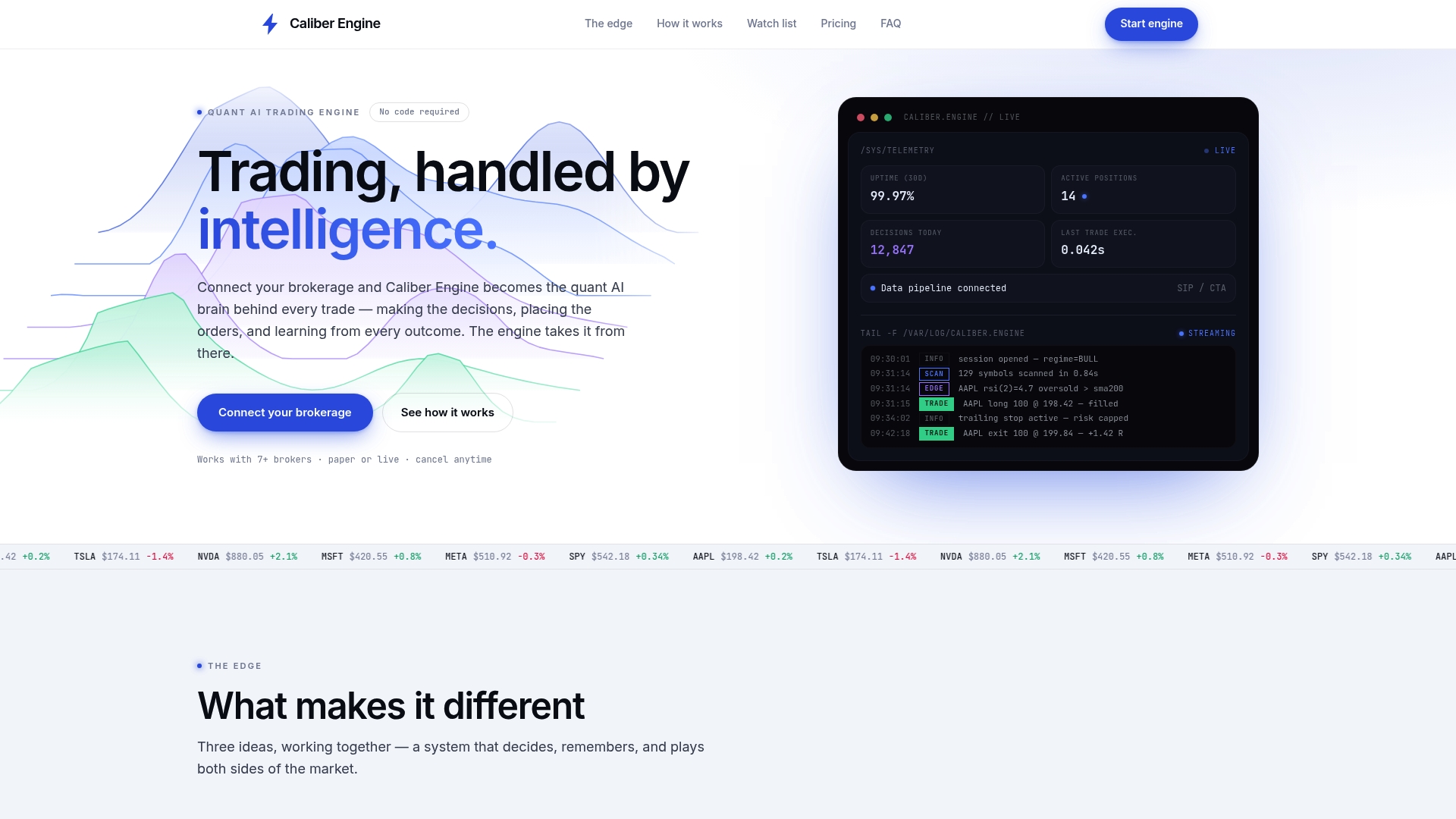
The concrete advantage over building your own system from scratch is time. Setting up a Python-based trading bot, connecting it to a broker API, and validating it properly takes months. Caliberengine compresses that to days. The self-learning engine refines its decisions based on your account's actual trade history, which means it adapts rather than running a static script indefinitely. Subscription tiers cover both fully autonomous trading and signal-only alerts for traders who prefer to approve each trade manually.
To get started: visit Caliberengine, connect your US brokerage account, select a strategy, and run it in paper-trading mode for at least four weeks before switching to live funds. That sequence, done in that order, is the lowest-risk path from zero to running a live AI trading strategy.
General information only, not investment advice. US traders should be aware of FINRA's pattern day trader rule, which requires a minimum $25,000 account balance for accounts flagged as pattern day traders. Confirm current regulations with FINRA or a qualified financial professional before trading.
Useful sources and further reading
- Quantitative trading — Investopedia
- Basics of algorithmic trading concepts and examples — Investopedia
- Algorithmic trading — Wikipedia
- AI Trading Platform: Step-by-Step Beginner's Guide (2026) — VentureBurn
- Beginners guide to quantitative trading — QuantStart
- Algorithmic Trading for Beginners — InvestingWithAI
- Quantitative Trading for Beginners — LedgerMind
- Caliber Engine — official site