

AI trading bots can be a legitimate tool for disciplined retail investors, but they are not a shortcut to consistent profits. The honest verdict: they work best as a systematic execution layer, not as a replacement for sound strategy. If you want to try one safely, follow this sequence: run a multi-week paper test on historical and live data, then ramp to 1% of your capital with hard stop-loss limits, then track realized drawdown and Sharpe ratio weekly before scaling further. Caliberengine is one production-grade platform worth examining as you read through this guide.
Table of Contents
- How do AI trading bots actually work?
- Do AI trading bots actually make money?
- What risks and scams should you watch for?
- How do you evaluate and choose an AI trading bot?
- How do you test an AI trading bot safely?
- How does Caliberengine approach automation and risk controls?
- Caliberengine: a production-grade starting point for serious traders
- Key Takeaways
- The gap between what AI bots promise and what actually matters
- Useful sources for further research
How do AI trading bots actually work?
An AI trading bot is software that converts data and a decision model into trade actions or signals, either executing orders automatically through a broker API or alerting you to act manually. The core architecture has three stages: data ingestion, model or strategy processing, and execution or signal output.
Typical data inputs include:
- Price feeds and candlestick history (tick, minute, daily)
- Order book depth and volume profiles
- News headlines and social sentiment scores
- Macro indicators (interest rates, earnings calendars, economic releases)
- Alternative data such as options flow or short interest
The model layer is where the real differences between platforms show up. Rule-based systems follow fixed logic ("buy when the 50-day moving average crosses above the 200-day"). Machine learning systems, including those using large language models, synthesize technical, macro, and sentiment signals across multiple agents that debate and refine strategies before committing capital. Research on multi-agent frameworks like 3S-Trader shows these systems can construct and self-refine portfolios without supervised retraining, which is a meaningful architectural leap from simple rule-based bots.
Two terms you will see constantly: autonomous mode means the bot places and manages orders without your input; signal-only mode means it sends alerts and you execute manually. For testing, always start with paper trading (simulated orders, no real capital) before moving to a forward test with live market data and real money.
A newer design pattern worth knowing: decoupled agentic architectures separate strategy analysis (done offline) from low-latency execution (deployed separately). This reduces inference costs and keeps execution fast, which matters when milliseconds affect fill prices.
Do AI trading bots actually make money?
They can, but the gap between backtest results and live performance is where most retail traders get burned. Backtests are constructed on historical data the model has already seen, which means overfitting is nearly universal. A strategy that looks exceptional on five years of S&P 500 data may fall apart the moment market structure shifts.
The most credible institutional example available: JPMorgan researchers reported their best multi-agent AI system beat a 60/40 portfolio by about 0.7 percentage point per year in backtests, with lower volatility. That is a sophisticated, well-resourced team, and the margin is modest. For retail users running off-the-shelf platforms, expecting double-digit alpha is not realistic.
| Metric | What to ask for | Why it matters |
|---|---|---|
| Maximum drawdown | Peak-to-trough loss in live or paper test | Tells you the worst real loss you would have absorbed |
| Sharpe ratio | Annualized return divided by volatility | A forward-test Sharpe above 1.0 is a reasonable threshold |
| Win rate | Percentage of profitable trades | Meaningless without average win/loss size |
| Slippage | Difference between expected and actual fill price | Hidden cost that erodes backtest gains in live trading |
| Latency | Time from signal to fill | Critical for high-frequency strategies; less so for swing |
Automated systems now execute a majority of U.S. market transactions, which means you are competing against institutional-grade infrastructure. Common failure modes for retail bots: overfitting to a specific market regime, survivorship bias in the training data, data gaps that inflate simulated returns, and transaction costs that are underestimated or ignored entirely.
The realistic benchmark: a retail-grade bot running a swing or trend-following strategy should be judged against a simple index fund, not against a hedge fund. If it cannot beat buy-and-hold on a risk-adjusted basis over a 90-day forward test, the subscription cost is hard to justify.
What risks and scams should you watch for?
The CFTC warns explicitly that AI-related claims for trading bots frequently mislead consumers, and that the primary risk shifts from emotional decision-making to technical configuration and execution errors. In plain terms: automation does not remove risk. It relocates it.
Red flags that should stop you from proceeding:
- Guaranteed returns or "risk-free" profit claims
- No verifiable forward-test records (backtest-only marketing)
- Opaque execution: no access to raw trade logs or exchange fill records
- Pressure to deposit quickly or to recruit others
- Unregistered operators (check NFA BASIC for futures/forex operators)
- No clear explanation of how the strategy generates edge
Pro Tip: Before committing capital, request raw trade blotters and exchange fill records, not just a summary P&L screenshot. A legitimate platform can produce timestamped order logs. If a vendor refuses or cannot provide them, treat that as disqualifying.
Custody and broker integration are also a safety issue. A bot that requires you to transfer funds to a third-party wallet or an unregulated exchange creates counterparty risk entirely separate from strategy risk. Prefer platforms that connect to your existing regulated brokerage account via API, so your capital stays in your name at a regulated custodian.
How do you evaluate and choose an AI trading bot?
Evaluate on four dimensions: transparency, risk controls, execution model, and forward-test evidence. Any vendor who cannot give you clear answers on all four is not ready for your capital.
Work through this checklist before signing up:
Strategy documentation: Can the vendor explain in plain language what market inefficiency the strategy exploits? Is there a whitepaper or model card?
Backtest methodology: What data was used? Were transaction costs, slippage, and market impact included? Was the backtest walk-forward validated or just in-sample?
Forward-test records: How long did the live or paper test run? What was the realized drawdown and Sharpe? Are the logs auditable?
API and broker integrations: Which regulated U.S. brokers does it connect to? Does it support direct market access or route through a third party?

Risk controls: Are stop-loss, position-sizing, and circuit-breakers configurable and independent of the strategy logic? Professional systems enforce position limits and kill-switches in a separate Risk Management System that operates regardless of what the strategy signals.
Automation mode: Fully autonomous execution or signal-only? For beginners, signal-only reduces the risk of a misconfigured bot running unattended.
On pricing, the three common models are monthly subscriptions, performance fees (a percentage of profits), and per-trade commissions. Subscriptions are predictable; performance fees align incentives but can be expensive if the bot trades frequently. Watch for platforms that charge both a subscription and a performance fee, since that combination is hard to justify unless live returns are well-documented.
Pro Tip: Read the contract's data-access clause. Some platforms retain ownership of your trade history and strategy parameters. If you ever cancel, you may lose access to your own performance records.
How do you test an AI trading bot safely?
The recommended sequence is: backtest review, then a 30–90 day paper test, then a small live allocation with hard risk caps. Never skip the paper phase, even if the vendor's marketing shows impressive historical returns.
-
Review the vendor's backtest (Week 1–2). Verify that transaction costs and slippage are included. Ask for the out-of-sample period separately from the in-sample training window. If the vendor cannot distinguish the two, the backtest is not credible.
-
Run a paper test for 30–90 days (Weeks 2–14). Use the platform's paper-trading mode against live market data, not historical replay. Track every metric the platform exposes: fill rates, simulated slippage, drawdown, and daily P&L. A 30-day paper test is the minimum; 90 days covers at least one earnings cycle and a range of volatility regimes.
-
Ramp to 1% of your intended allocation (Week 14–18). Keep a hard stop: if drawdown exceeds 3% of the live allocation in the first month, halt and diagnose before adding capital.
-
Scale to 5% if Week 14–18 results match paper-test expectations (Week 18–26). The key word is "match." If live slippage is materially higher than paper-test slippage, the strategy's edge may not survive real execution.
-
Move to target allocation only after 90+ days of live data (Week 26+). By this point you have enough realized data to compare against the vendor's claimed metrics.
During live testing, monitor these signals weekly:
- Realized slippage vs. expected slippage from the backtest
- Maximum drawdown vs. the vendor's stated drawdown limit
- Execution latency (especially for intraday strategies)
- Fill rate: what percentage of orders execute at or near the target price
- P&L attribution: is the return coming from the stated strategy or from a single anomalous trade?
Set alerts for drawdown thresholds. A bot running unmonitored for two weeks can compound losses faster than most traders expect. Weekly review is a minimum; daily is better during the first 90 days.
How does Caliberengine approach automation and risk controls?
Production-grade platforms decouple strategy analysis from execution and maintain independent risk-management systems. Caliberengine is built on this principle: its quantitative AI engine analyzes market data and generates decisions separately from the order-routing layer that executes them.
Here is what the platform offers U.S. equity and ETF traders specifically:
- Autonomous mode: The engine connects to your existing brokerage account via API and executes trades without requiring your input, long and short positions included.
- Signal-only mode: If you prefer manual control, the platform delivers real-time alerts so you decide when to act.
- Self-learning architecture: Caliberengine logs every trade outcome and uses that data to refine its parameters over subsequent cycles, a closed-loop improvement process consistent with what production-grade systems use to adapt without supervised retraining.
- No coding required: API integration with your broker does not require programming knowledge.
- No fund transfer: Your capital stays in your brokerage account; Caliberengine connects to it, not the other way around.
| Platform signal | Caliberengine specification |
|---|---|
| Supported assets | U.S. equities and ETFs |
| Automation modes | Fully autonomous and signal-only |
| Broker integration | API connection to existing brokerage accounts |
| Self-learning | Closed-loop trade-outcome logging and parameter refinement |
| Capital custody | Funds remain in user's own brokerage account |
Pro Tip: Use the trial period to run Caliberengine in signal-only mode first. Compare its alerts against your own analysis for two to three weeks before switching to autonomous execution. This gives you a concrete read on whether the strategy logic matches your risk tolerance before the bot places a single live order.

Caliberengine: a production-grade starting point for serious traders
Spending months evaluating platforms that lack transparent track records is a real cost. Caliberengine cuts that process short by giving you a verifiable starting point: an autonomous quant AI that connects to your brokerage account, trades U.S. equities and ETFs, and documents every decision for review.
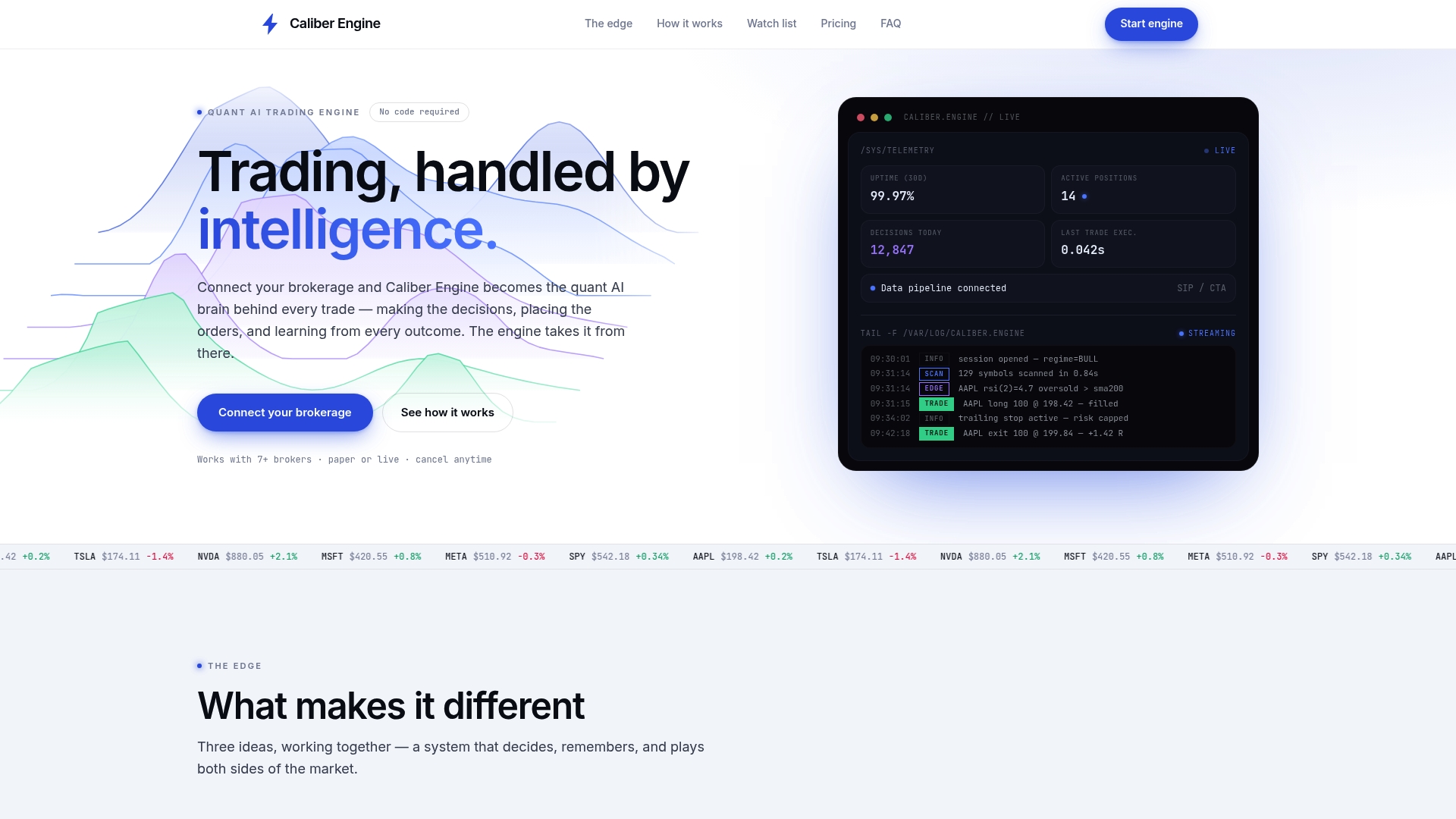
The trial lets you validate the three things that matter most before committing: whether the platform's live signals match its documented strategy, whether execution latency and slippage stay within the ranges the platform claims, and whether the self-learning loop actually adjusts after losing trades. Unlike platforms that require you to move funds to a third-party account, Caliberengine keeps your capital at your existing broker. Start a trial at caliberengine.ai and run it in signal-only mode for the first two weeks. That alone will tell you more than any marketing page.
Key Takeaways
AI trading bots add the most value as a systematic execution layer when paired with rigorous forward-testing, independent risk controls, and realistic performance benchmarks.
| Point | Details |
|---|---|
| Test before you fund | Run a 30–90 day paper test on live market data before committing any real capital. |
| Demand forward-test records | Backtest results alone are insufficient; ask for auditable logs of live or paper-test performance. |
| Require independent risk controls | Choose platforms with stop-loss and position-sizing systems that operate separately from strategy logic. |
| Reject guaranteed-return claims | The CFTC flags these as a primary fraud indicator; no legitimate bot guarantees profits. |
| Caliberengine as a benchmark | Caliberengine keeps funds at your broker, and offers both autonomous and signal-only modes for U.S. equities and ETFs. |
The gap between what AI bots promise and what actually matters
The conversation around AI trading bots tends to collapse into two camps: true believers who expect the algorithm to print money, and skeptics who dismiss the whole category as a scam. Both miss the point.
The honest case for automated trading systems is narrower and more defensible than the marketing suggests. A well-configured bot removes the two most destructive behaviors in retail trading: panic selling during drawdowns and overtrading during volatile sessions. That alone has real value. The problem is that most retail traders never get to test whether a bot actually delivers that discipline, because they fund it before they understand it.
What I would actually do: run any new platform in signal-only mode for at least three weeks, compare its calls against a simple momentum benchmark, and only switch to autonomous execution after the live signal quality matches the documented strategy. The self-learning capability that platforms like Caliberengine describe is genuinely interesting, but it only compounds in your favor if the base strategy is sound to begin with. Verify the foundation before you trust the refinement loop.
The regulatory picture reinforces this. The CFTC's advisory is not a warning against using bots. It is a warning against using them without understanding the configuration risk you are taking on. That is a meaningful distinction, and it is the right frame for any serious evaluation.
Useful sources for further research
| Source | Why it matters |
|---|---|
| CFTC Customer Advisory on AI Trading Bots | The primary U.S. regulatory warning on AI trading claims and fraud vectors; essential reading before funding any platform. |
| Automated trading system — Wikipedia | Solid overview of how automated systems work, their market share, and documented failure modes including flash crashes. |
| 3S-Trader: Multi-LLM Framework — arXiv | Peer-reviewed research on multi-agent AI portfolio construction; useful for understanding what modern architectures can and cannot do. |
| TiMi: Trade in Minutes — arXiv | Explains decoupled agentic architecture for quantitative trading; relevant for evaluating platform design claims. |
| Automated trading system — QuantInsti | Practitioner-level explanation of independent risk-management systems and why they matter for retail users. |
| NFA BASIC Registration Check | Verify whether a futures or forex trading operator is registered with the NFA before depositing funds. |
This article is general information, not investment or financial advice. Confirm current regulations and platform terms with a qualified financial professional before trading.